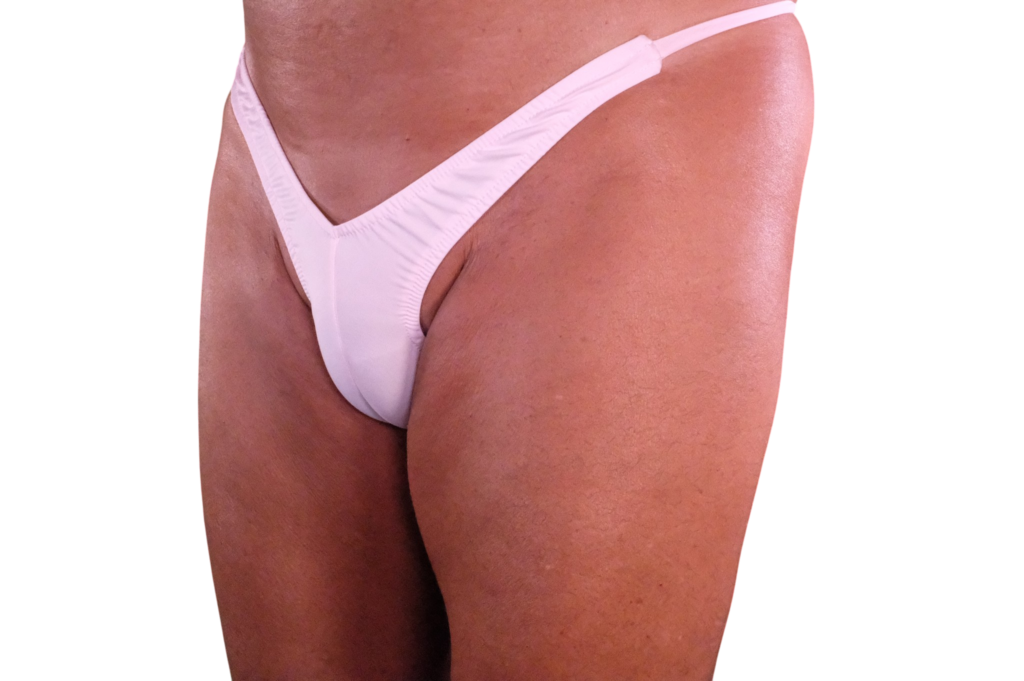
MTF Transformation and the Vagina Look: From Feminizing Swimwear to Gender-Affirming Surgery
For many people pursuing a male-to-female transformation, one of the most personal questions is what they want their genital area to look like.
Some transgender women ultimately want gender-affirming genital surgery. Others have no interest in surgery but want a feminine appearance when wearing underwear, leggings, or swimwear. Still others are gender-fluid, nonbinary, femboys, crossdressers, or feminine men who enjoy creating a temporary feminine silhouette without permanently changing their anatomy.
There is therefore no single definition of a successful MTF transformation.
At one end of the spectrum is something as simple as specialized MTF swimwear that creates a smooth front. At the other is gender-affirming surgery that creates vulvar anatomy and, depending on the procedure, a vaginal canal.
Between those points are tucking, gaffs, compression garments, shaping panties, prosthetic vulvas, specialized positioning garments and devices, hormone therapy, orchiectomy, vulvoplasty, and other options.
Understanding the differences is important because these approaches accomplish very different things.
First: Vagina and Vulva Are Not the Same Thing
Every discussion of this subject benefits from an anatomical distinction.
The vulva refers to the external genital structures.
The vagina is the internal canal.
Consequently, when someone says they want to “look like they have a vagina” while wearing a bikini, they generally mean they want the external appearance of a vulva or simply a smooth feminine genital silhouette.
Swimwear, tucking, prosthetics, and shaping garments can change external appearance.
They do not create a vagina.
Surgery can permanently reconstruct external genital anatomy, and some surgical procedures can also create a vaginal canal.
That distinction separates presentation from anatomical transformation.
There Is a Whole Spectrum of MTF Transformation
It can be useful to imagine the options as a spectrum:
Feminine swimwear → compression → gaffs → tucking → specialized shaping → prosthetics → medical transition → orchiectomy → vulvoplasty → vaginoplasty
Nobody has to travel from one end to the other.
Someone might remain perfectly happy with MTF bikinis forever.
Another person may tuck every day.
Another may use hormones but never want genital surgery.
Another may eventually pursue vaginoplasty.
These aren’t levels that someone must complete. They are independent choices.
Option 1: MTF Swimwear
The easiest and most reversible approach is clothing.
Modern MTF swimwear can be designed specifically for people with external genitalia who want the appearance of conventional feminine swimwear.
Instead of using the anatomical pouch common in men’s swimsuits, the front can be designed to minimize projection.
The difference can be dramatic.
A conventional men’s bikini says, visually, “there is a pouch here.”
An MTF bikini can intentionally do the opposite.
Its objective may be to create a compact, smooth front that blends naturally into the lines of the bikini.
For someone exploring feminine presentation, this can be an excellent starting point because nothing about the body itself has to change.
Put the swimsuit on and the silhouette changes.
Take it off and the transformation is over.
Option 2: Compression Swimwear
Compression provides another relatively simple solution.
Rather than performing a complete tuck, strategically placed stretch fabric holds external anatomy closer to the body.
This can substantially reduce the visible bulge.
The result depends on anatomy, garment construction, and the amount of compression being used.
For some people, compression alone produces the appearance they want.
It can be particularly useful for people who want a smooth feminine bikini front without complicated preparation.
The objective should always be secure comfort rather than maximum possible compression. Pain, numbness, discoloration, swelling, or skin injury are reasons to stop using the garment and reassess the fit.
Option 3: Gaffs
The gaff is one of the traditional tools of feminine presentation.
A gaff is a compression garment designed to create a flatter genital profile.
Modern versions range from relatively substantial underwear to garments that resemble conventional panties, bikini bottoms, or thongs.
A gaff can also be worn underneath another garment.
For example:
gaff + bikini = feminine exterior with additional support underneath.
Integrated designs can accomplish a similar effect without requiring two separate garments.
Gaffs are particularly useful because they are completely reversible and don’t require medical intervention.
Option 4: Tucking
Tucking goes beyond simply compressing a bulge.
The external genitalia are carefully repositioned and supported to produce a flatter front.
For many pre-op and non-op transgender women, tucking can dramatically change the appearance of underwear and swimwear.
Instead of a prominent male-shaped front, the bikini can lie considerably flatter against the body.
This can make traditionally feminine styles much easier to wear.
Tucking is also inexpensive and reversible, which is why it remains one of the most common approaches to creating a feminine silhouette.
Tucking Swimwear
Purpose-designed tucking swimsuits combine the fashion garment and support system.
This has significant advantages at a beach or pool.
A swimsuit has to function while:
walking,
swimming,
sitting,
getting in and out of the water,
and moving around normally.
A well-designed tucking swimsuit therefore needs more than a tiny front panel. It requires sufficient stretch, compression, coverage, and stability.
For many transfeminine wearers, the result can look remarkably similar to conventional women’s bikini bottoms.
Option 5: Feminine Shaping Garments
There is a difference between making the front flat and making it appear specifically feminine.
A perfectly flat panel doesn’t necessarily resemble natural external female anatomy.
Consequently, some garments use shaping and contouring to create a more feminine exterior.
The swimsuit itself can influence perception through seams, padding, contour panels, fabric tension, and the overall bikini cut.
This can be combined with tucking or compression.
The result is essentially visual illusion through fashion engineering.
And because swimwear is already highly form-fitting, relatively small changes in shape can have a surprisingly large visual effect.
Option 6: Specialized Feminizing Devices
There are also specialized positioning devices marketed for temporary genital feminization.
Depending on their construction, these products may reposition or contain external tissue so that it is less prominent underneath clothing.
They occupy a middle ground between ordinary tucking garments and prosthetic solutions.
These products vary substantially, however, and should not be treated as medically equivalent simply because they produce similar cosmetic results.
Anything applying concentrated pressure to genital tissue requires particular care.
Pain, persistent numbness, swelling, skin damage, significant discoloration, or urinary problems are warning signs that the device should be removed.
A temporary visual transformation should never require injuring the anatomy underneath it.
Option 7: Prosthetic Vulvas
Another completely different approach is a prosthetic.
A realistic prosthetic vulva can create female-looking external anatomy without surgically altering the wearer’s body.
Depending on the product, it may be designed primarily for appearance under clothing or for a more realistic appearance when uncovered.
This can appeal to someone who wants a much stronger visual transformation than ordinary tucking provides but isn’t seeking surgery.
Prosthetics have an important psychological advantage for some wearers:
they allow experimentation.
Someone can experience seeing their body with a very different external appearance without making a permanent medical decision.
Combining Techniques
These categories aren’t mutually exclusive.
Someone might use compression together with specialized swimwear.
Another person might tuck and then wear an MTF bikini.
Someone using a prosthetic might choose underwear designed to keep it securely positioned.
This is where modern MTF clothing becomes particularly interesting.
Instead of relying on a single transformation technique, the body, shaping method, and garment can work together to create the final silhouette.
Micro and Ultra-Micro MTF Swimwear
Feminizing swimwear doesn’t necessarily have to provide substantial coverage.
There are also micro bikinis, thongs, and extremely minimal MTF designs.
This creates an interesting reversal of conventional thinking.
A wearer can simultaneously show more skin while displaying less male genital contour.
The swimsuit becomes smaller while the visible bulge becomes smaller too.
That combination can create an especially feminine appearance because women’s micro swimwear uses many of the same visual elements: narrow sides, high-cut legs, tiny fronts, and minimal backs.
The challenge is security.
The less fabric a swimsuit contains, the more precisely it needs to fit.
The Non-Op Trans Woman
Not every transgender woman wants genital surgery.
This is an important point.
Transition does not have a mandatory destination.
A trans woman can use feminine clothing, change her name and presentation, take hormones, have other gender-affirming procedures, or make none of those medical changes and still decide that genital surgery isn’t right for her.
For someone who remains non-op, MTF swimwear and underwear can be particularly valuable.
They allow the external presentation to change when desired without requiring permanent genital reconstruction.
Hormone Therapy Changes the Body Differently
Gender-affirming hormone therapy belongs in another category entirely.
Estrogen-based hormone therapy can produce broader physical changes over time, such as breast development, changes in body-fat distribution, reduced muscle mass, changes in skin, and often changes in sexual function and genital tissue.
However, hormones do not transform a penis into a vagina.
This distinction matters.
Hormones can feminize the body substantially, but someone wanting permanent reconstruction of the external genital anatomy needs to consider surgical options separately.
Hormone therapy also has genuine medical risks and should be managed with an appropriately qualified clinician rather than approached as a cosmetic clothing technique.
Orchiectomy
An orchiectomy is surgical removal of the testicles.
For some transgender women, it represents an intermediate surgical step.
Removing the testes can reduce testosterone production substantially and changes the volume of tissue in the genital region, but it does not create a vulva or vaginal canal.
Someone who has undergone orchiectomy may still use tucking or smoothing swimwear if desired.
An important consideration for anyone contemplating later vaginoplasty is that future surgical plans should be discussed with the gender-affirming surgeon before choosing procedures that might affect tissue potentially useful for reconstruction.
Vulvoplasty
Vulvoplasty is one of the major surgical options for someone whose priority is external female genital anatomy.
The procedure reconstructs external genital structures but generally does not create a full-depth vaginal canal.
It is sometimes described as zero-depth or shallow-depth vaginoplasty, although terminology and specific surgical techniques vary.
For the right patient, this can offer an important compromise.
Someone may strongly desire permanent female-looking external anatomy but have little or no interest in vaginal receptive intercourse.
Vulvoplasty can therefore eliminate the need to create and maintain a full vaginal canal while still providing substantial external genital reconstruction.
This is a decision that requires detailed consultation with an experienced gender-affirming surgical team.
Vaginoplasty
Vaginoplasty represents the most extensive option on this spectrum.
Gender-affirming vaginoplasty reconstructs the genital anatomy to create a vulva and a vaginal canal.
There are multiple surgical techniques.
The appropriate procedure depends on factors including anatomy, medical history, available tissue, previous surgery, surgeon expertise, patient priorities, and desired vaginal depth.
This is major surgery rather than a cosmetic styling technique.
It involves medical evaluation, preparation, recovery, follow-up care, and potential complications. Depending on the technique, ongoing postoperative care such as dilation may be required.
Anyone considering it should receive individualized information from qualified clinicians and experienced gender-affirming surgeons.
Surgery Isn’t Simply a More Advanced Version of Tucking
This distinction is especially important.
Tucking, gaffs, MTF swimwear, prosthetics, and surgery may all create a superficially similar result when someone is wearing a bikini:
a feminine-looking front.
But medically they are completely different.
Swimwear changes clothing presentation.
Tucking temporarily changes positioning.
A prosthetic changes external appearance.
Hormones change aspects of the body’s secondary sex characteristics.
Surgery permanently reconstructs anatomy.
Someone shouldn’t view surgery as something they are supposed to “graduate” toward after using feminizing swimwear.
It is an independent medical decision.
Choosing How Far You Want to Go
This is ultimately one of the most important questions in MTF transformation.
How much transformation do you actually want?
Someone might discover that wearing an MTF bikini provides everything they were looking for.
Another person may realize that they want to present as female every day but don’t want genital surgery.
Another may find that seeing a smooth feminine silhouette confirms something much deeper about how they want their body to be.
There isn’t a universally correct answer.
Temporary experimentation can actually be useful precisely because it gives someone room to understand their feelings.
A Practical Transformation Spectrum
Think of the choices this way:
Fashion transformation: feminine bikinis, panties and gender-fluid clothing.
Silhouette transformation: compression garments and smooth-front swimsuits.
Positioning transformation: gaffs and tucking garments.
Cosmetic transformation: specialized shaping systems and prosthetics.
Whole-body medical feminization: clinician-managed hormone therapy and other gender-affirming treatments.
Limited genital surgery: procedures such as orchiectomy.
External genital reconstruction: vulvoplasty.
External and internal genital reconstruction: vaginoplasty.
These aren’t eight steps in a program.
They are eight different categories of choice.
A person can stop anywhere—or combine appropriate approaches.
From a Men’s Bikini to an MTF Bikini
One of the simplest demonstrations of this transformation can happen entirely through clothing.
Imagine two nearly identical spandex bikinis.
The first contains an anatomical male pouch.
It supports and outlines the genitals.
The second uses compression and specialized MTF construction.
It minimizes them.
Put the first one on and the presentation can appear unmistakably masculine.
Put the second one on the same body and the presentation can become substantially more feminine.
The anatomy hasn’t changed. The silhouette has.
That illustrates the remarkable possibilities of modern gender-fluid swimwear.
When the Vagina Look Becomes More Than Fashion
For some people, experimenting with MTF swimwear is simply fashion.
For others, it can become personally significant.
Seeing yourself with a feminine genital silhouette may produce feelings of comfort, recognition, excitement, relief, indifference, or even uncertainty.
Any of those reactions can provide useful information about what you actually want.
Someone considering permanent medical transition does not have to draw conclusions from a single experience, however.
Major medical decisions deserve time, careful consideration, qualified professional guidance, and a realistic understanding of benefits, limitations, recovery, fertility implications, sexual function, and possible complications.
The Beach Can Be a Powerful Milestone
Swimwear makes gender presentation unusually visible.
Everyday clothing can conceal body shape.
A bikini generally does the opposite.
For a transgender or gender-fluid person, being able to put on a bikini, look down, and see the silhouette they wanted can therefore be an important moment.
For one person that may involve nothing more than compression swimwear.
For another it may involve tucking.
For someone who has undergone gender-affirming surgery, putting on an ordinary bikini without needing those techniques can carry entirely different significance.
All three experiences can represent successful gender expression.
From Temporary Illusion to Permanent Transformation
The modern MTF transformation spectrum offers something earlier generations had far less access to: choice.
Someone who wants a feminine appearance for an afternoon at the pool may only need specialized swimwear.
Someone wanting a smoother appearance every day might prefer gaffs, tucking garments, or shaping underwear.
Someone seeking broader physical feminization may explore medical transition with qualified clinicians.
Someone who permanently wants female external genital anatomy may eventually consider vulvoplasty.
And someone who wants both reconstructed external anatomy and a vaginal canal may consider vaginoplasty.
These choices differ enormously in cost, medical risk, recovery, reversibility, and physical outcome.
But they share a common principle:
the individual gets to decide what degree of transformation is right for their own body.
MTF Transformation Is About Choice, Not a Finish Line
Perhaps the biggest misconception about male-to-female transformation is that everyone is traveling toward exactly the same destination.
They aren’t.
One person wants to look feminine in a swimsuit.
Another wants to live socially as a woman.
Another wants hormone therapy but no surgery.
Another wants a vulva without a full-depth vaginal canal.
Another wants vaginoplasty.
And someone else may experiment with several forms of gender expression before deciding that permanent physical changes aren’t right for them.
Modern MTF swimwear is significant because it makes the beginning of that spectrum extraordinarily accessible.
A swimsuit can temporarily change a silhouette.
A gaff or tuck can take the transformation further.
Specialized shaping and prosthetics can create another level of visual change.
Medical transition can feminize the body.
Gender-affirming surgery can permanently reconstruct genital anatomy.
There is no requirement to travel the entire distance.
The most meaningful transformation is not necessarily the most dramatic one. It is the one that allows an individual to live and present in a way that feels right for them.
For some people, that destination is a feminine bikini and a smooth front.
For others, it is gender-affirming surgery.
And for many, it will be somewhere in between.